
You automated everything. Now what? Just put AI on top of it.
Why Enterprises Pay Half a Trillion Dollars Annually for Manual Work Behind Their Workflows


Enterprise automation is a magic trick.
The audience sees the result and thinks it’s magic. Seamless. Effortless. Fully automated.
Leadership sees dashboards showing automated workflows. Real-time updates. Clean integrations. Everything connected.
But every magic trick has manual work hidden from view. Operations teams copying contract details across three systems. Reading PDF invoices and typing amounts into ERPs. Searching email threads to find who approved what. Checking ServiceNow, then Jira, then Slack to update a single ticket. The automation handles part of it. Humans handle the rest.
The people watching believe it’s all automated. The people performing know better. And sitting between them is a half-trillion dollar outsourcing industry built on keeping the manual work hidden. The trick only works if nobody looks behind the curtain.
What’s Actually Happening
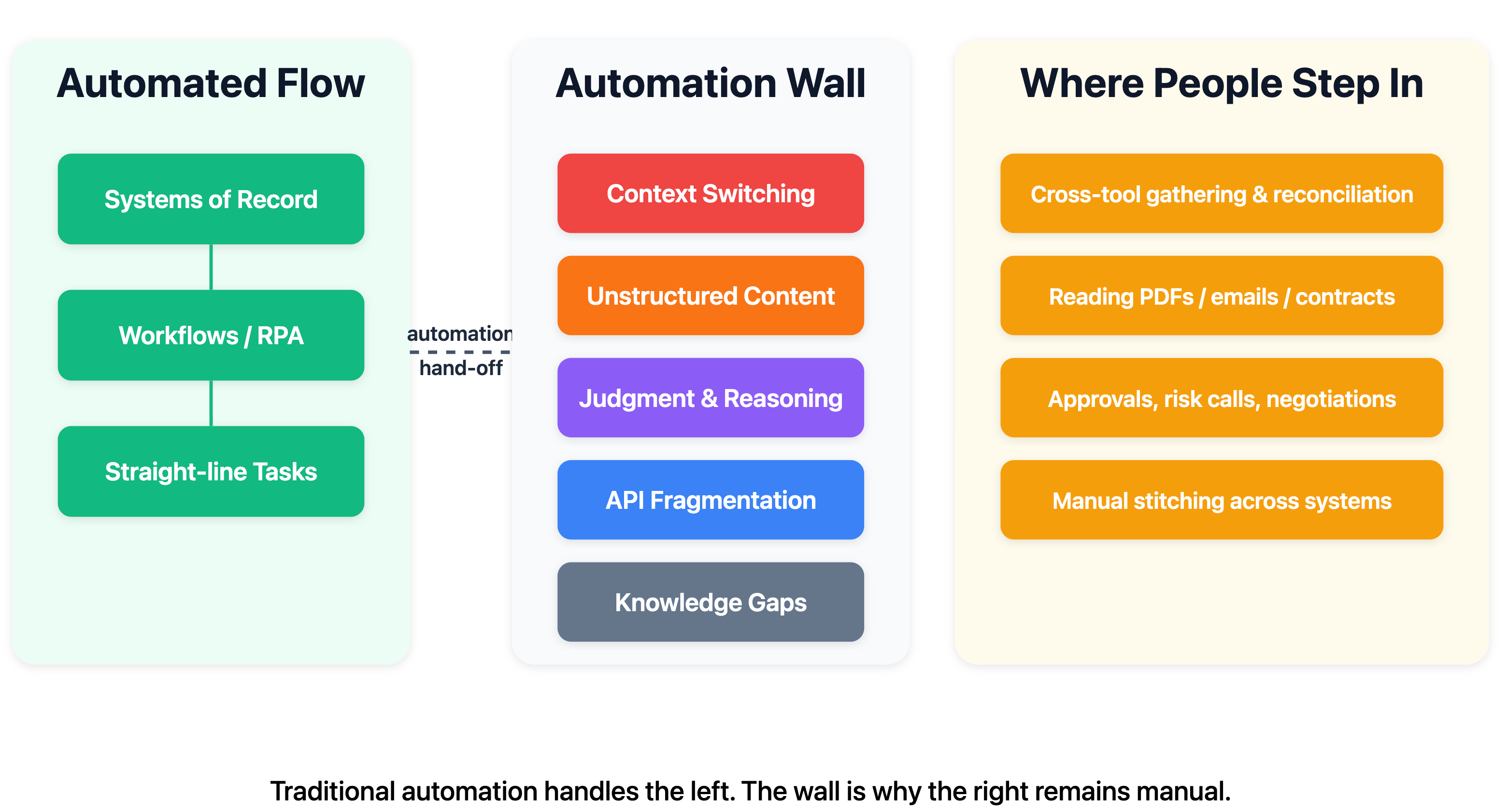
We automated the obvious stuff. Workflows trigger on schedule. SOAR platforms handle security playbooks. Zapier and n8n connect APIs. RPA bots fill out forms. If the task is predictable, the data is structured, and the systems have APIs, it works great.
Then you hit the wall.
Context Switching Someone needs to copy contract details from an email, paste them into Salesforce, then manually enter the same information into NetSuite because the integration only handles certain fields. They check Slack for approvals. Check Teams for the legal review. Check their email for the final signed version. Update a Jira ticket after checking ServiceNow and Datadog to figure out what actually broke. Pull customer info from the CRM, re-enter it into the ERP, then copy it again into the ticketing system. Your Workflow Builder platform can’t orchestrate across all of them because half don’t have the right API endpoints. Every piece of information lives in a different system, and someone has to be the integration layer.
Unstructured Content A PDF invoice arrives. No structured data, just a scanned document with amounts in various formats. Someone reads it, finds the total, types it into the ERP. A contract comes in for review. Someone manually extracts the liability clauses, the termination terms, the payment schedule, and puts them into compliance fields. An Excel attachment shows up in email with merged cells and custom formatting. The automation breaks. Someone pulls the data out manually. Screenshots of error messages get converted into structured ServiceNow tickets because your workflow platform can’t read images. Long email threads get parsed to find the actual decision that was made because context matters and automation just sees text.
Judgment and Reasoning An IT ticket comes in. Your workflow automation can route based on keywords, but it can’t tell if “server down” is critical or just someone’s laptop acting up. Context matters. A security alert fires. Your SOAR platform can auto-respond to known threats, but this one’s ambiguous. Is it a real phishing attempt or someone testing the system? Someone has to decide. An expense goes over the approval limit, but it’s urgent and the vendor only takes this payment method. The workflow stops. Someone evaluates and approves it manually. Audit evidence has gaps. Someone maps it to controls and determines what’s actually missing. A vendor sends three quotes. Someone evaluates risk, cost, and timing to choose one because no automation can weigh tradeoffs like that.
API Fragmentation
The Salesforce connector worked fine until the schema changed. Now someone maintains custom scripts to keep your n8n workflows running. Zapier connects two tools, but a third tool has no connector, so CSV imports become the workaround. The authentication method changed from OAuth to API keys, and someone manually updates it across 12 integrations. Your automation platform supports 2,000 apps, but the three internal tools you actually need aren’t on the list. When systems update, automations break, and someone stitches them back together.
Internal and Legacy Apps With No APIs Your company built internal tools years ago. Admin portals, approval systems, reporting dashboards. No APIs for gathering data or taking actions. Someone logs in, clicks through multiple pages, copies data, pastes it elsewhere. Custom apps built on Oracle or SAP that require manual navigation to pull reports or update records. Workday modules where you extract data by hand because the API doesn’t cover what you need. Vendor portals that haven’t been updated since 2015. Insurance carrier websites where you manually check claim status and submit requests. Banking portals where you log in to download statements or initiate transfers. Government compliance sites where you fill out forms and check statuses manually. These systems aren’t going anywhere, and most will never have proper APIs.
Knowledge Gaps Someone needs to onboard a new vendor but the process isn’t documented. They search Confluence, Notion, Slack, and email to figure out how it was done last time. An exception request comes through, but nobody knows who approved the last one or why. Last year’s audit procedures aren’t written down anywhere. IT needs to set up Okta policies, so they ask SMEs who set them up before. The knowledge exists somewhere, scattered across tools and people’s heads, and someone manually curates it into something usable.
This is the wall. Six categories of work that SOAR, RPA, and workflow platforms can’t handle. And they’re not edge cases. They’re daily operations.
The Half-Trillion Dollar Workaround—How MSPs and BPOs Built an Industry on What Automation Can’t Handle
So what do enterprises do when they hit the wall? They don’t solve it. They outsource it.
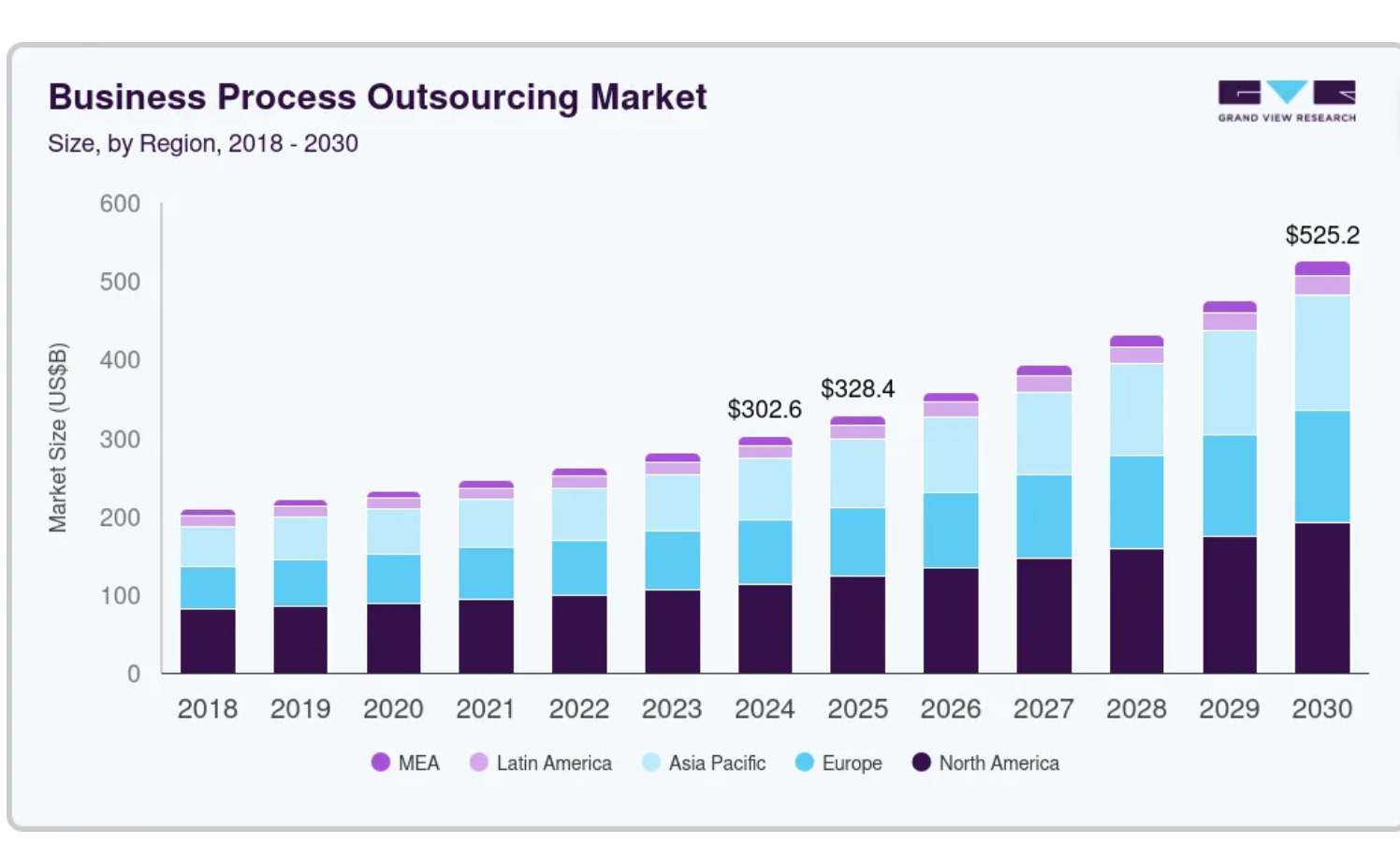
The global BPO market was worth around $303 billion in 2024 and is projected to hit $525 billion by 2030 Business Process Outsourcing Market | Industry Report, 2030. MSPs and BPOs have built an entire industry around doing the work that automation can’t handle. Context switching? They hire people to manually move data between Salesforce, NetSuite, ServiceNow, Jira, and Workday because the integrations don’t cover everything. Unstructured content? They staff teams to read PDFs, extract data from contracts, and parse email threads. Judgment calls? They train analysts to evaluate security alerts, approve exceptions, and make risk decisions.
API gaps and automation maintenance? They maintain armies of people who build and fix your Zapier workflows, maintain n8n integrations, update RPA bots when they break, and write custom scripts when connectors stop working. Wait—even building the workflows gets outsourced to India. You pay for automation tools, then you pay someone offshore to build and maintain the automations. The automation itself requires manual work to keep running.
And those legacy apps and internal portals with no APIs? MSPs staff entire teams just to handle them. People who log into Oracle-based admin systems, navigate Workday modules to pull reports, check insurance carrier websites for claim statuses, download statements from banking portals, and fill out government compliance forms manually. Every internal tool your company built years ago without an API, every vendor portal that never got updated, every system that requires clicking through pages to get data out—someone at an MSP or BPO is doing that work for you.
It works. Sort of.
You get the work done. Your workflows show green. Your dashboards look automated. Leadership believes the systems are running themselves. But you’re paying for it. The United States alone is expected to generate $153 billion in BPO revenue in 2025 Business Process Outsourcing - Global | Market Forecast. That’s not money spent on technology or infrastructure. That’s money spent on people doing manual work because the automation stopped.
https://www.grandviewresearch.com/industry-analysis/business-process-outsourcing-bpo-market
And it’s not just cost. It’s slow to scale. Need to handle 30% more volume? You hire more people, train them, onboard them. It takes months. It creates knowledge silos. The people doing the work know how things actually run, but that knowledge lives offshore, scattered across teams, and never makes it back into your systems or documentation. When someone leaves, the knowledge leaves with them.
The BPO model also fragments your operations. Finance and accounting outsourcing alone holds over 21% of the market, while IT and telecommunications accounts for over 24% Business Process Outsourcing Market | Industry Report, 2030. You have one vendor handling finance operations, another doing IT support, a third managing customer service. Each one operates independently. Nobody has the full picture. The context switching problem you were trying to solve? You just made it worse, except now it’s happening between vendors instead of between systems.
MSPs and BPOs aren’t the problem. They’re doing exactly what enterprises are paying them to do. They handle the work that sits on the other side of the automation wall. But here’s the thing: this isn’t solving the automation problem. It’s just moving manual work somewhere else and calling it handled. The wall is still there. It’s just offshore now.
Conclusion
The automation wall isn’t going away on its own. Enterprises automated what they could. SOAR, RPA, and workflow platforms handle the predictable stuff. MSPs and BPOs handle everything else. That’s a $525 billion industry by 2030, built entirely on the gap between what automation can do and what actually needs to get done.
AI changes the equation. But only if it’s built for the right problems. Making workflows slightly better won’t do it. Another departmental tool won’t do it. Fixed products that can’t adapt won’t do it. Low-code platforms that turn IT teams into AI engineers won’t do it.
What will? Building for the messy middle where automation breaks down. Handling context switching across Salesforce, NetSuite, ServiceNow, and Jira without manual copying. Reading unstructured content like PDFs, contracts, and email threads and knowing what to do with it. Making judgment calls on ambiguous situations beyond keyword matching. Working with legacy apps and internal portals that have no APIs. Synthesizing knowledge scattered across Confluence, Slack, and tribal knowledge. And doing it with customers through forward deployed engineering. Understanding their environment. Handling the complexity. Getting them to ROI fast.
The companies that figure this out won’t just build better automation. They’ll change how enterprises actually work. The wall comes down when someone’s willing to do the hard work of tearing it down. That’s the opportunity.
 | A guest post by
|
Brilliant articulation of the automation wall - I've seen this play out at multiple enterprises. Your ServiceNow/Jira/Datadog context-switching example is painfully accurate. What really resonates is the insight about outsourcing not solving the problem, just moving it offshore. The $525B BPO market you cited is essentially arbitrage on manual labor costs, not actualy solving the root issue. The part about API fragmentation hit hard - we spend so much time maintaining Zapier workflows and custom connectors that break whenever a schema changes. The real opportunity you're pointing to is AI that can handle the 'messy middle' - unstructured content parsing, judgment calls on ambiguous situations, legacy system navigation. This is where agents could genuinely transform enterprise ops if they're built for these specific pain points rather than just being another workflow automation layer.